
Egypt’s real estate tax law, also known as the property tax law, has recently undergone many amendments. The new regulations are in favor of the taxpayers, making the process of buying, selling, and investing in real estate way easier.
Maybe you have heard about these amendments, but didn’t understand how they are useful? Do you need more detailed elaboration on the benefits of the law updates?
No worries, in this article, we will cover all the relevant details: the original real estate tax law, its amendments, and how this tax is calculated.
All you need to do is stay focused for a 10-minute read!
What is Egypt’s Real Estate Tax?
Despite going through various amendments, the main concept behind the real estate tax stays unchanged. The main idea is taxing the rental value of real estate at a certain rate, which is set in Egypt to be 10%.
The real estate tax law in Egypt mentions the exceptions, exemptions, and all the other cases that are not taxable. Don’t forget that there is a difference between exempt real estate and non-taxable real estate.
Exempted real estate is buildings that should have been taxed but were exempted under certain conditions the law lists. These cases include having a rental value less than the taxable one, or non-profit use buildings, yet there are more cases.
While the non-taxable real estate is the buildings that are originally not subject to the taxing system. Those include, but are not limited to, state-owned buildings, religious-use buildings, and under-construction buildings.
Note that Egypt imposes an average of 2.5% capital gains tax on real estate. It’s a tax imposed on any gains generated from selling a good.
How is the real estate tax exactly calculated on properties? Find out in the following section.
Egypt Real Estate Tax Calculation
The real estate tax rate is 10% of the net annual rental value -not the market value- of the taxable property. This net value of the properties is calculated by deducting maintenance and management costs—30% for residential and 32% for non-residential—from the gross annual rental value.
Take into consideration that properties under 2 million EGP are exempt, as are properties with a total annual rental value below 6,000 EGP
Let us clarify the process with an example. Assume that you own an apartment whose annual rental value is 120,000 EGP:
- Deducting maintenance and management expenses calculated at 30% for residential units
120,000 EGP X 30% = 36,000 EGP
- Thus, the net annual rental value of the unit is
120,000 EGP – 36,000 EGP = 84,000 EGP
- Then deduct 24,000 EGP, the value of the exemption on the units (according to the tax law, units below 24,000 EGP are exempt from paying the property tax)
84,000 EGP – 24,000 EGP = 60,000 EGP
- The real estate tax = the tax rate x the net value of the unit after the deductions
60,000 EGP X 10% = 6,000 EGP
Thus, you need to pay a 6000 EGP annual tax for your property.
In fact, this is how the property tax is calculated for all units, such as properties in compounds such as O West by Orascom or mixed-use projects such as Sumou Boulevard.
Now that you know the calculation of the real estate tax, let us tell you the latest amendments and updates to the real estate law as of March 2026.
Understand the difference between capital growth & rental income
Real Estate Tax Amendments & Facilitations
To facilitate investment and better regulate the real estate tax, the government announced a series of amendments and measures in March 2026. The official law for these amendments was issued in April 2026.
The new updates came in Law No. 3 for 2026, which lists the following:
- Raising the tax exemption threshold to 100,000 EGP, increasing the total exemption value to 8 million EGP
- Owners of many units no longer have to submit their exemption declaration to various tax offices; instead, they can submit all their declarations to any one of them
- Gradually transforming to digital platforms instead of offices
- The taxes are effective on the units from the date of submitting the declaration, meaning that citizens will not be taxed for the old non-registered or non-listed units, which is a step towards encouraging citizens who fear paying for all their non-registered units
- Offering a 25% discount on the tax value for residential uses to help persuade taxpayers to pay on time
- Canceling late payment penalties to help encourage those who have penalties to pay without fearing paying a large amount
- Abolishing the authority of the real estate tax districts to appeal rental valuations, and appeals can now be filed electronically
- Pending disputes can be settled with only 70% of the disputed tax
Real Estate Tax Offices
So, you know the new amendments, and you are encouraged to go submit your tax declaration, where would you go?
Egypt, in the meantime, has 44 RETA branch offices, “Maamouria,” where you can submit, dispute, and pay your taxes. Yet, don’t forget that the government is currently encouraging people to use the new digital platforms as part of the Digital Egypt Builders Initiative.
Major offices include:
- Fifth Settlement Tax Office (real estate) Building 31 – Mostaqbal Housing
- First Settlement Tax Office (real estate) Building 215 – Al-Mogaora Al-Thania (Second Neighborhood ) – apartment 32
- Maadi Tax Office (real estate) 28, 6 Street behind Al-Farouq Mosque and Banque Misr
- Madinaty Tax Office (real estate) Inside Madinaty Compound
- Shorouk Tax Office (real estate) Square 28 – Building 33 – opposite Al Shorouk Public Hospital – Flat 1. 2
- West Cairo Tax Office (real estate) 3 A Al Sahafa Street Al-Esaaf
By now, you know almost all about the Egyptian real estate tax, its calculation, and the latest amendments, but didn’t you wonder what’s about the origins? Know in the following lines.
Egypt’s Real Estate Tax: A Historical Account
Let us tell you how the property tax laws in Egypt evolved. Here is a detailed account of the history and evolution of real estate tax in Egypt:
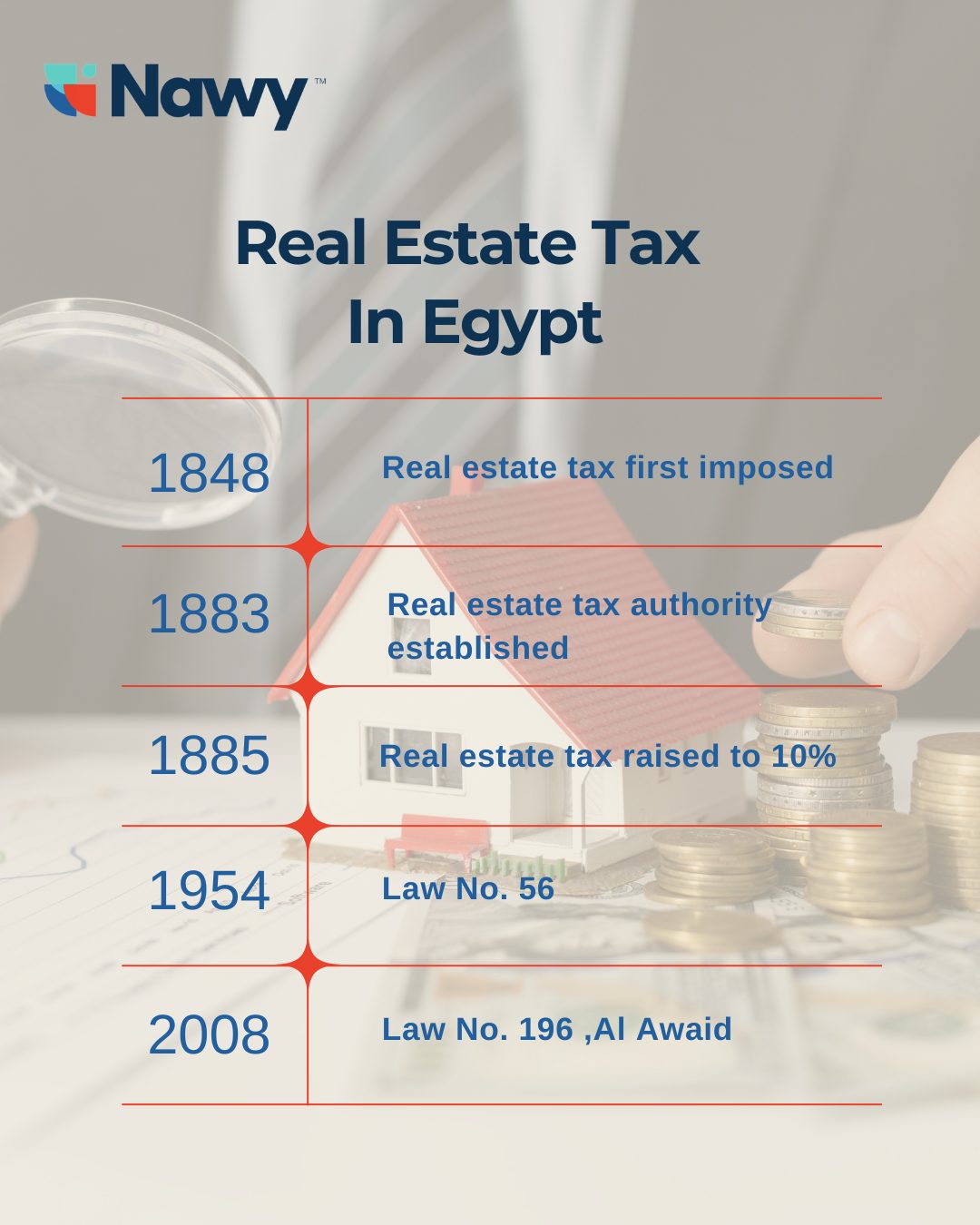
- 1842: During Mohamad Ali’s reign, the government imposed a real estate tax with a value of 1/12 of the building’s rent value on Egyptians
- 1854: The law witnessed new amendments
- 1875: New legislation added
- 1883: The government established an official Real Estate Taxation Authority (RTA), an institution that specializes in all the laws and regulations related to real estate in Egypt
- 1885: The government raised the real estate tax rate to 10%
- 1954: The government issued Real Estate Tax Law No. 56 of 1954 to bring new legislation to the pre-existing law
- 1961: The Tax Law No. 129 added more details and regulations to the law
- 2008: The Tax Law No. 196 became the main legislation with which real estate in Egypt is taxed
Since then, the real estate tax in Egypt sometimes goes by the name “Al-Awaid.”
Wrapping Up
In this article, we tackled the following:
- Egyptian real estate tax meaning and history: starting in 1885, the government imposed a real estate tax of 10% is on all residential and non-residential units, with some exceptions
- Real estate tax calculation with an example: a rate of 10% of the total net rental value of the unit. Calculated by deducting 30% for residential units and 32% for non-residential units of management and maintenance costs
- Real estate tax amendments & facilitations as of March 2026: the government announced many updates added to the law. They have the sole aim of facilitating the process and encouraging more people to pay their taxes
Now that you know all the related details, let us tell you what the next steps are.
Taking Action
By now, you know all the details related to the Egyptian real estate tax law and its regulations. The new amendments made to this law will help facilitate the process of buying, selling, and investing in real estate properties in Egypt.
So, don’t waste your time, go check Nawy’s website and check all the available properties to pick the best-fitting option for your needs and preferences. The process is as easy as just choosing your unit, contacting our team, and finalizing the deal.
FAQs
What Is Capital Gains Tax On Real Estate?
The government levies a Capital gains tax (CGT) on the profit made from selling real estate. It is a 2.5% of the total sale value.
How Much Is Capital Gains Tax On Real Estate?
2.5% from the total sale value
How Much Is Real Estate Tax?
10% after deducting 30% management costs for residential units and 32% for non-residential units
How To Calculate Real Estate Tax in Egypt?
real estate tax rate (10%) x net rental value of the unit after deducting maintenance and management costs