

Real estate property registration in Egypt is an essential step for securing ownership rights and protecting investments. Understanding the process and knowing the required documents beforehand would save you time.
Proper registration ensures legal protection and prevents disputes, whether you are purchasing a residential unit, commercial property, or land. That’s why, in this article, we will break down everything you need to know about property registration in Egypt, from the required documentation to the steps, and where the offices are located.
Real Estate Property Registration in Egypt
To register real estate property in Egypt, you must follow a structured legal framework. It was designed to safeguard ownership rights and streamline procedures. This system is primarily governed by Law No. 114 of 1946, which laid the foundation for property registration in the country.
In 2022, it was modernized by Law No. 9, which introduced simplified processes and reduced requirements to encourage formal registration. & Last year, Law No. 88 of 2025 was introduced.
It presented a National Real Estate Identification system, assigning each property a unique digital ID. This not only facilitates secure transactions but also improves transparency and ensures accurate property records across Egypt.
This digital ID would be required for all legal dealings.
Now, let’s take a look at the documents required for real estate property registration in Egypt.
Documents Required for Property Registration
Before you start the real estate property registration process, it is important to have a set of official documents ready.
These documents verify the identities of all parties, confirm ownership rights, and prove that the property is free from disputes or financial liabilities.
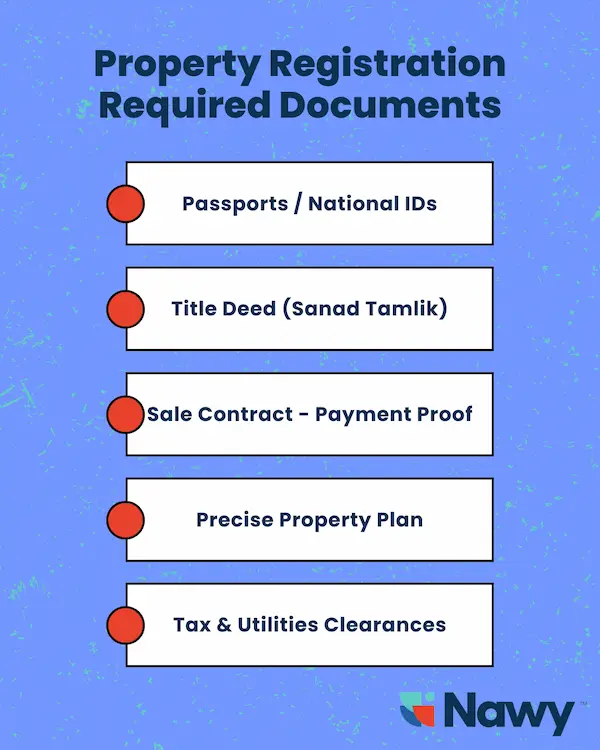
Documents required for real estate property registration in Egypt include the following:
- Identification
Passports or Egyptian national IDs of all buyers and sellers.
2. Seller’s Title Deed (Sanad Tamlik)
The seller’s existing Sanad Tamlik to establish their ownership. This confirms their right to sell the property.
3. Sale Contract
A fully executed and signed sale agreement between the buyer and the seller is to be submitted to the registry as the basis for transfer.
4. Precise Property Plan
You should submit a certified property plan outlining precise boundaries. The Real Estate Registry requires precise map coordinates (neighborhood, block, parcel numbers).
5. Tax & Utilities Clearances
Certificates from the Real Estate Tax Authority should be submitted to confirm there are no outstanding taxes, along with recent utility receipts (electricity, water, or gas).
6. Proof of Payment
To verify that the buyer has funded the purchase as claimed, you will need bank receipts or transfer documents showing that the sale price was paid.
It’s worth noting that there are two main authorities in Egyptian property transfers: The Notary Public and the Real Estate Publicity Department.
Notary Public & REPD
The Notary Public (Shahr El-Aqari) is one of the main authorities in Egyptian property transfers. Its role revolves around authenticating sale contracts.
Every geographic area has a notary office. When you sign a contract there, the notary verifies identities and ensures the transaction meets legal requirements. It’s also worth noting that it only validates the contract for use.
The Real Estate Publicity Department (REPD) is a part of the Ministry of Justice. It is the official registry of land and buildings. When somebody submits a notarized contract, REPD examines and records it in the national registry.
Real Estate Property Registration Steps in Egypt
In order to verify ownership, ensure legal compliance, and officially transfer title to the buyer, registering your real estate property in Egypt is a structured process. Following each step will help you avoid delays or legal complications.
Steps for real estate property registration in Egypt:
- The process starts with title verification and due diligence. The buyer first checks the seller’s title and tax records. & once cleared, both parties sign an initial sale contract.
- Afterwards, you apply for a cadastral survey certificate to confirm the property’s exact boundaries and legal description (through the Technology Center for Real Estate Cadastral Registration Platform).
- Next, you submit the Registry (REPD) at Shahr El-Aqari. Both parties should have their IDs as the notary validates the contract by confirming identities, as well as the sale contract, the previous title deed, cadastral map, tax/utility clearances, and proof of payment. The contract is officially recorded at the notary’s office after paying a formal fee. P.S: If any document is missing, the application will be suspended, and the buyer is notified to submit the missing papers (that’s why collecting the required documents is the most important first step!).
- The Survey Authority may inspect the property on-site afterwards. This technical inspection is to ensure the property matches official records.
- Next, you will pay the registration tax and any stamp duties (should be paid before the final approval). Then, these receipts are added to the application file.
- Afterwards, the REPD reviews your file. Registration takes around 37 days from filing. 30 days are for processing, leaving 7 days for appeals. Complicated cases might take longer.
- Finally, once approved, the transaction is registered in official records. Then, a new title deed (Sanad Tamlik) is issued in the buyer’s name.

Technology Center for Real Estate Cadastral Registration
In step 2, we mentioned applying for a cadastral survey certificate, a cornerstone element in Egypt’s modernized property registration framework. The Ministry of Planning and Economic Development manages it.
The Technology Center for Real Estate Cadastral Registration facilitates the technical aspects of the process. It is a mandatory step where you submit an online application for a “Documented Survey Certificate” and pay the required fees before heading to the REPD.
Furthermore, according to Law No. 88 of 2025, it supports creating the digital ID.
After learning the required documents and the essential steps, it’s time to know where you are heading. Next, we will tell you about some of the real estate property registration offices in Egypt.
Real Estate Registration Offices in Egypt
At Khadamat Misr Center, Street 9, in El Nafoura Square.
77 Street, behind Maadi Court.
In 6th of October City Sporting Club
- East Cairo
New Cairo has several dedicated Real Estate Registration and Notary offices. They serve various areas. Some of them are situated in El Zohour Club, Madinaty, and Al Rehab.
Additionally, real estate property registration is transitioning to an online-friendly process by the Ministry of Justice. To manage initial property verification, tax processing, and schedule registry appointments, you can do it through the official Digital Egypt Portal.
Finally
Gathering the required documents first and following the steps mentioned above would ensure you finish registering your property with no hassle. Moreover, the Digital Egypt Portal offers you an online-friendly process.
For any real estate questions, contact Nawy, Egypt’s top prop-tech company. Call us on 15211, and our consultants will assist you with all your inquiries.